
Gaia’s Founding Co-Director, Liz Hosken, reflects on her ‘hammock talk’ with Indigenous leader and long-time affectionate ally, Ailton Krenak. This conversation was convened by our dear friends at Selvagem in Brazil. Watch the talk in full:
I was blessed to meet passionate allies who became friends and mentors in the 1980s and early 1990s. People were gathering across our planet to reflect on four decades of ‘development’ since WW2 and how social and ecological injustices were growing exponentially. Jose Lutzenberger, known fondly as the father of Brazil’s environmental movement, introduced me to Ailton Krenak: a fiercely outspoken Indigenous leader. Ailton spoke compellingly about the profound relationship Indigenous Peoples have with the territories from which their identity is derived. We spent many hours talking, exploring indigenous cosmology, and he became a dear friend.
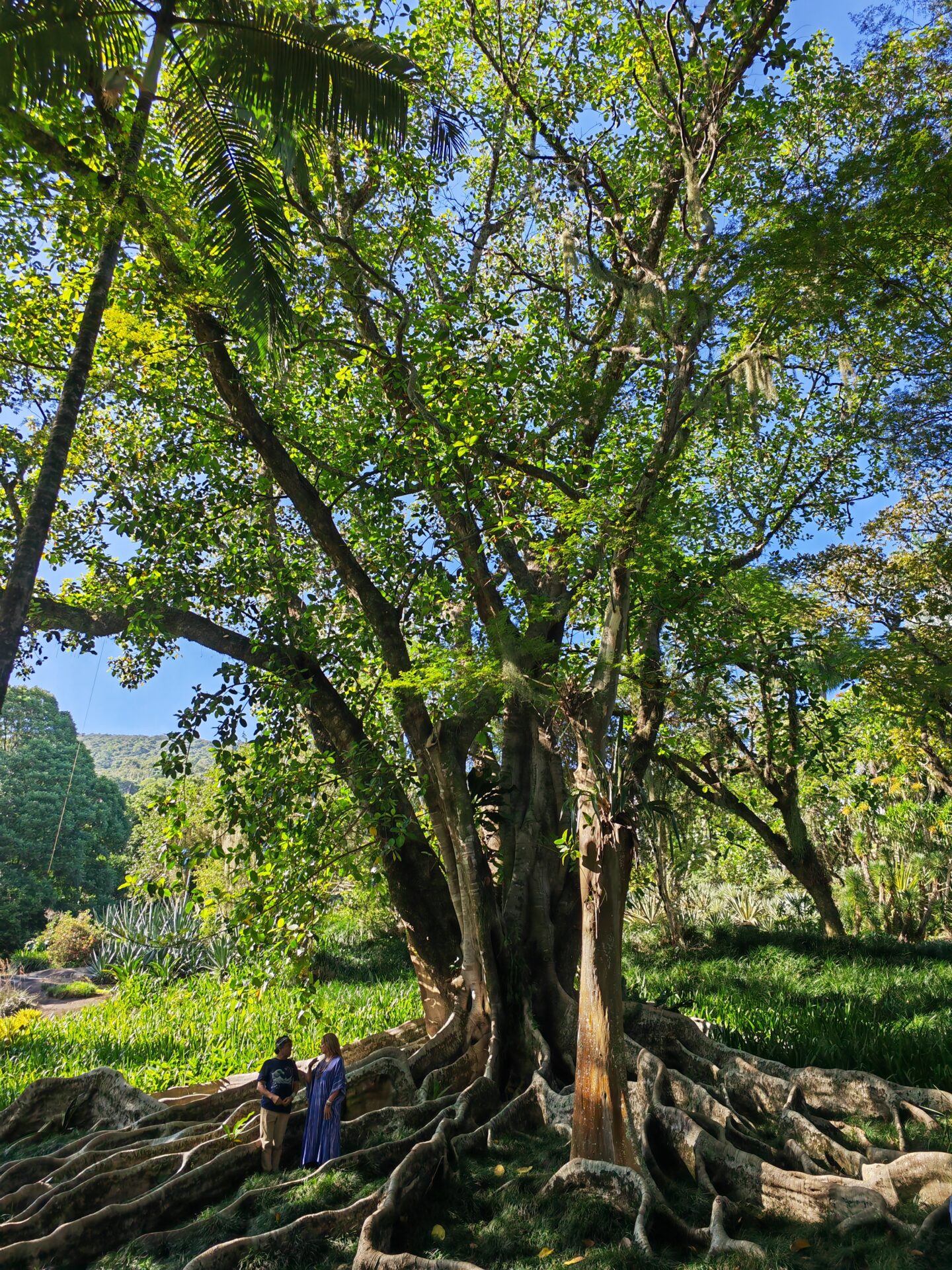
Ailton and Liz under a ficus tree in Brazil 2025, by Grace Iara Souza
“The sacred has this power to uproot us from our place, and dissolve us into the landscape. This persistent way of being on Earth, which is expressed in the communal way of living together, of being close to a place, caring for a place, could be a remedy for so much violence. And it is the defenders of these ways of being in the world who are also threatened, vulnerable, because the machinery that is driving the consumption of life on the planet is impersonal. It expresses itself in the devouring of the world. This observation, over decades, makes me realise now, in the 21st century, that two organisms which are very sensitive are suffering a simultaneous attack: the body of the small communities and the body of Gaia.” Ailton Krenak
He spoke poetically about the memory that Indigenous people hold of how humans are part of the web of life and as such participate consciously in life’s cycles, living according to Mother Earth’s laws.
“Our ancestors, up until 2000 years ago, had a broad perception of the whole as sacred. The window of time during which humanity has assumed this predatory position is very recent. So, we can still look at some places on Earth with the restorative power that we so yearn for.” Ailton Krenak
Ailton introduced me to one such place: the Ashaninka Indigenous community in Acre, in the north-west Brazilian Amazon. They invited me to participate in some Ayahuasca ceremonies where I met the world of plant teachers for the first time. This was an experience of connecting to the consciousness that permeates life. What an awesome planet, where these extraordinary plant and animal relatives have such wisdom to share with us if we are open to it!
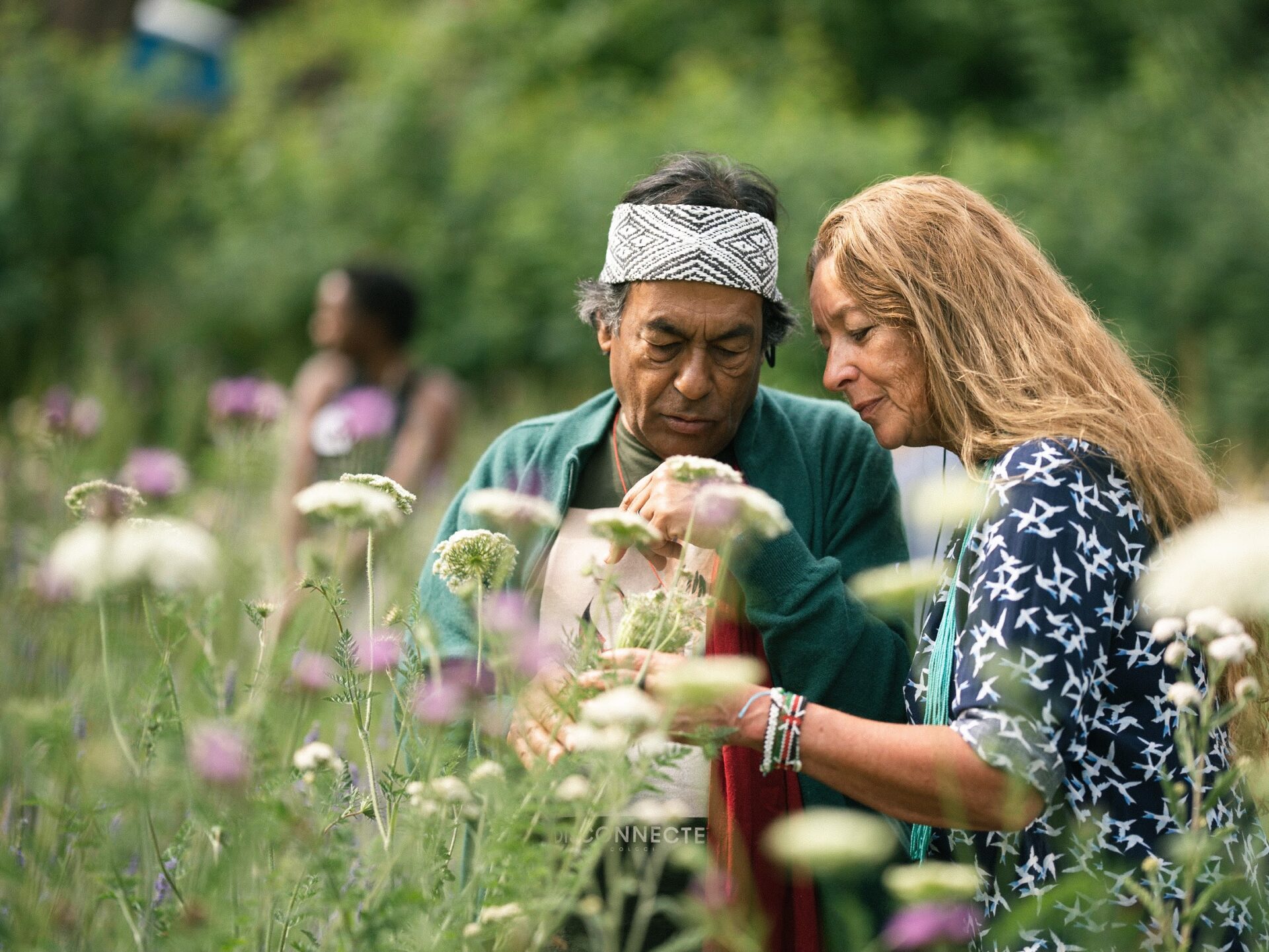
Ailton and Liz in London 2023, by Will Hearle, courtesy of OmVed Gardens, Flourishing Diversity, Where the Leaves Fall and Synchronicity Earth
Ailton emphasized the importance of building ‘affectionate alliances’ between Indigenous Peoples and those from the dominant world who are concerned about the critical condition of life on our planet. Indigenous Peoples, he said, cannot hold the responsibility of protecting life alone. They need allies, willing to work together with care, on this long healing journey. This was the seed of The Gaia Foundation, through which we could walk alongside each other in our common commitment to protect the forest and indigenous lifeways. It opened a way for restoring the memory of who we are – Earthlings, first and foremost.
“That reminds me, Liz, that it was you and my dear Edward (Posey, Gaia’s Co-Founder) who introduced me to the hypothesis of Gaia. You opened that portal, and connected us with allies in South America, Colombia and other forested places. For a long time, you were the voice expressing this emergency…The forests are disappearing. The mechanisms for intervention – the climate conferences, all these intellectual, logical discussions – have proved incapable of providing any clue. And Gaia cries out. The Earth cries out. But I have hope, which presupposes action, in movements and collectives today. Like those advancing the Rights of Nature, which is an idea that’s consistent with the understanding that Gaia is a living organism.” Ailton Krenak
-

- Ailton gifting Ed one of his first paintings, for the walls of Gaia House, London 1990

-
- Ed and Ailton meeting again after many years, London 2023

When James Lovelock proposed the Gaia Hypothesis – that our wonderous Earth-planet is a whole, self-regulating organism – he didn’t realise, as a scientist, that he was invoking the Earth Mother goddess in people’s memories. Suddenly, in the 80s, people were talking about Gaia again, and Pachamama and all the other names we know her by.
Today, we find ourselves in a polycrisis caused by the industrial growth economy, where those Indigenous Peoples who are reviving their traditions are also sustaining the memory of what it is to be human: a living cell in the body of Gaia. We are witness to an extreme devouring of our planet, and yet there’s also a hunger for a more meaningful understanding of life. What Ailton and the Ashaninka showed me, is that working with the power of ancestry and of spirit, is aligning with the life force of Mother Earth. That was my sense of what held them strong, in the face of enormous threat.
“There’s a broad reality surrounding us today which is the struggle for the conquest of the body of Gaia. We’re facing an almost cannibalistic event. How can Indigenous communities continue to confront this monster head-on while 80% of the planet’s population is consuming, consuming, consuming? I feel compelled to criticise this thing that has become almost a religion. When I rose up in my youth to create the indigenous movement, I met many people along the way who thought that we could flirt with capitalism and wake up alive the next day. I am suspicious. I think capitalist fury wants to devour me and you. I can’t normalise this economic violence of the world overriding everything. For a long time, the economy has dominated minds to the point that all other issues have become subordinate. The great oracle is capitalism.” Ailton Krenak
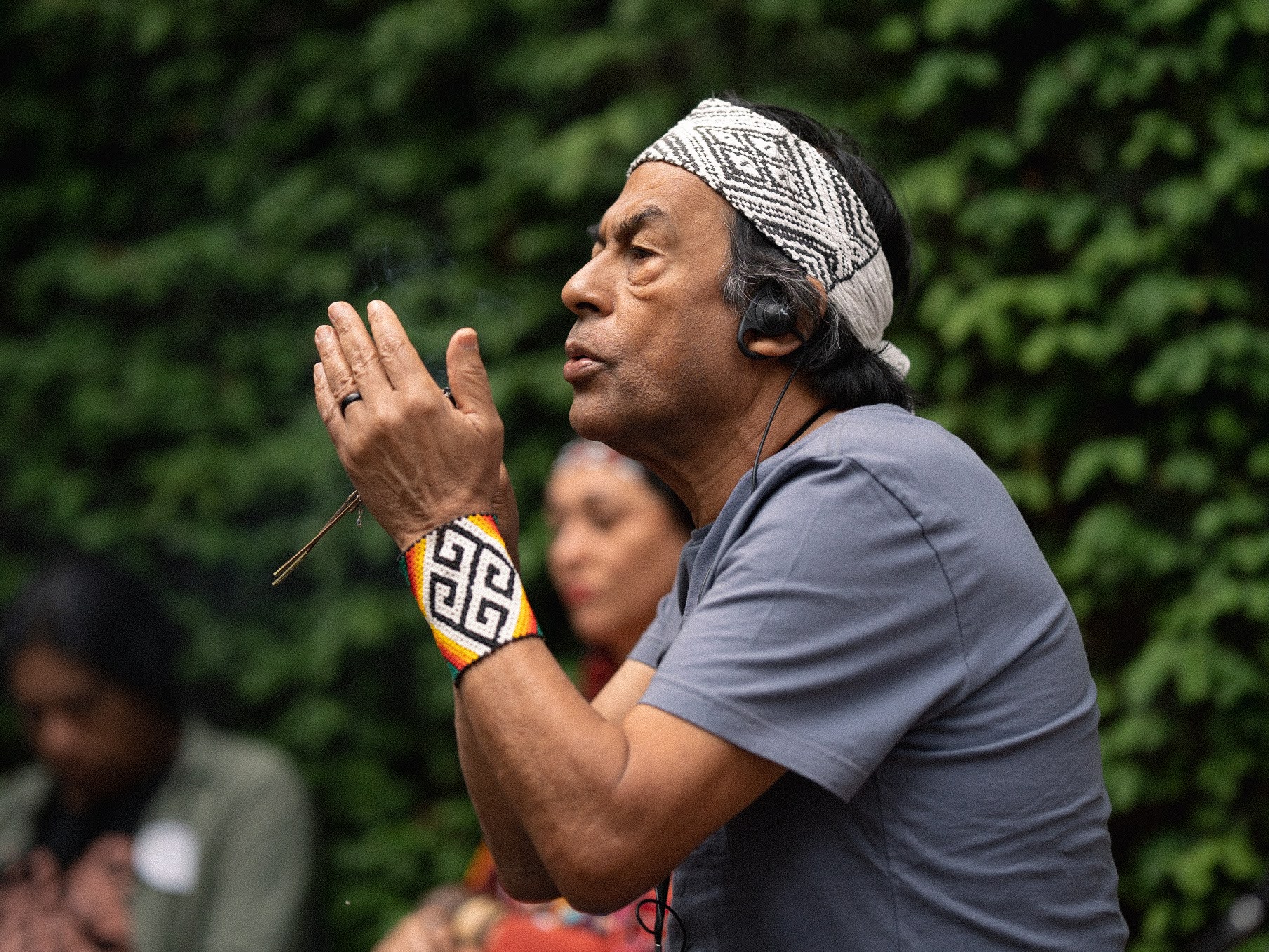
Ailton Krenak, by Will Hearle, courtesy of OmVed Gardens, Flourishing Diversity, Where the Leaves Fall and Synchronicity Earth
And yet, as we know from Gaia herself, life is dynamic and self-regulating. We are seeing the horror unfold ever more intensely, and there is also a growing counterculture, inspired by those Indigenous communities who have stayed strong. It is an awakening, a yearning for restoring meaningful relationships, not only with humans. Our role – those of us who love life and are called to defend it – is to invoke the uniting spirit of Gaia and nurture that counterculture. We don’t know what the result will be, but what else can we do but care for life, and inspire those around us?
“There’s a parable that frequently visits me, in different times and places I travel, which says that a boy once asked an elder what to do about two wolves who were quarrelling in his mind. When the boy asked, ‘which of the two wolves will win?’ the elder answered the boy, ‘the one you feed best, the one you take the most care of.’ This parable could illustrate our dialogue. The deranged wolf who wants to eat everything or the one threatened with extinction… Who are we feeding? Who is the world feeding?” Ailton Krenak
So this, perhaps, is my question. How can we remain aware of and alert to the devouring force, without feeding it more energy? If we get too caught up in it, it devours us as well. We are called, instead, to deepen our practices of nurturing life, of hearing the cries of Gaia and responding to them. To counter the dominant paradigm with cultures of care. That is surely the dance of our time.
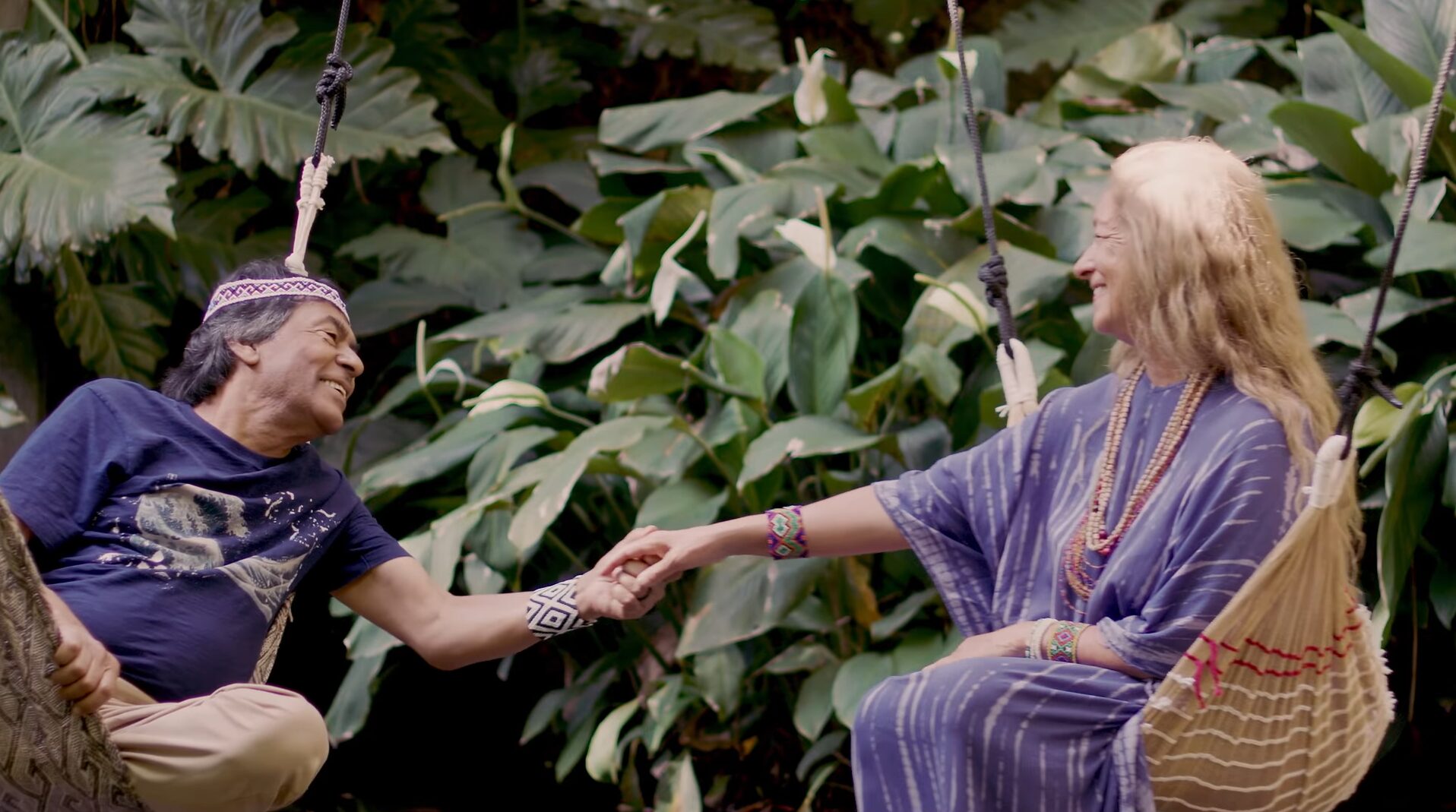
Heartfelt thanks to the Selvagem team, especially Anna Dantes and Madeleine Deschamps, for organising and producing this hammock talk, as well as to Anna and Rodrigo Fiaes for hosting Liz in Rio de Janeiro with so much care.